The FARI Brussels Conference returns on 23 and 24 November, find out more!
An Initiative of
Supported by

Deepen your expertise in Retrieval-Augmented Generation by building, testing and comparing real-world RAG systems across two intensive hands
This advanced, hands-on training focuses on implementing, debugging, and evaluating Retrieval-Augmented Generation (RAG) pipelines. Participants will build a complete RAG system using LangChain, explore monitoring and optimisation techniques, and compare code-based and no-code solutions such as Langflow and Microsoft Copilot Studio.
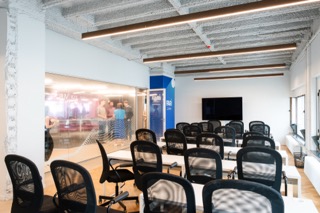
Build, debug and deploy powerful RAG systems with confidence.
Training content
This advanced, practice-oriented training focuses on the implementation, debugging and evaluation of RAG pipelines. Participants will build a complete RAG system using code-based frameworks and explore no-code/low-code alternatives, enabling informed architectural choices in real deployment contexts.
This training is part of a three-day RAG course series. Days 2 and 3 form a consecutive technical module and cannot be attended separately. While Day 1 (March 18) focuses on conceptual foundations, Days 2 and 3 are dedicated to hands-on implementation and require a technical background. Participants registered for the full 3-day program receive a €50 discount. To register for the complete program, register on day 1 and add-on days 2 and 3 in the checkout process.
This training will be conducted in English.
Program
DAY 2
Morning – Building RAG with LangChain
– Introduction to LangChain concepts (chains, retrievers, prompts)
– Assembling a complete RAG pipeline step by step
– Using multiple LLMs within a single workflow
– Managing prompts and retrieval strategies
Afternoon – Monitoring, Debugging and Optimisation
– Tracing and monitoring with LangSmith
– Diagnosing retrieval and generation errors
– Analysing latency, costs and response quality
– Iterating on chunking, retrieval and prompting strategies
DAY 3
Morning – Visual and No-code RAG Solutions
– Building RAG pipelines with Langflow / Flowise
– Visual configuration of loaders, chunking, embeddings and retrievers
– Local execution and cloud-based deployment considerations
Afternoon – Cloud-based RAG & Comparative Workshop
– Creating RAG-based agents with Microsoft Copilot Studio
– Connecting to structured and unstructured knowledge sources
– Code-based vs no-code architectures
– Strengths, limitations and suitable use cases
– Trade-offs in flexibility, maintainability and scalability
Target audience
Developers (backend, full-stack)
Data, ML and AI engineers
Technical consultants and solution architects
IT and digital teams responsible for AI implementation
Trainers
Alexandra SEBASTIEN
Trained in biology and ecology, Alexandra SÉBASTIEN initially focused on social insects (ants and honey bees), their behaviour, bacteria and viruses, and later their proteins. She completed her Bachelor’s and Master’s degrees at Université Pierre et Marie Curie before obtaining a PhD from Victoria University of Wellington in 2016. She subsequently carried out postdoctoral research at the University of British Columbia, where she continued to integrate empirical research with quantitative analysis.
Over time, her work evolved from field and laboratory investigations toward data-driven approaches. This transition led her to undertake a complementary Master’s degree in Big Data at Université Libre de Bruxelles, completed in 2025. She is motivated by analytical problem-solving and by the effort to interpret complex datasets. With the rapid acceptance and use of artificial intelligence in everyday life, she is particularly interested in the societal implications of these tools and in the importance of deploying them in a responsible and constructive manner.
Lyan ALJENDI
Lyan Aljendi is a generative AI engineer at ULB currently focused on building impactful solutions in education. She previously worked on applying generative AI in medical research during her master’s thesis, and she is especially interested in using AI to create positive change in the public sector. She earned a bachelor’s in Software and Information Systems Engineering from Homs University and completed a master’s in Computer Science at ULB in 2025, where she received the Babbage Prize for academic excellence.
Dates
24 March 2026
25 March 2026
Languages
English
Venue
BeCentral, FARI Auditorium, Cantersteen 16, 1000 Brussel
Fees
Ticket - Day 2 & 3
400 euros
3-Day Pass (Day 1 + 2 + 3) – Discounted Rate
750 euros
Contact details
academy@fari.brusselsRegister here